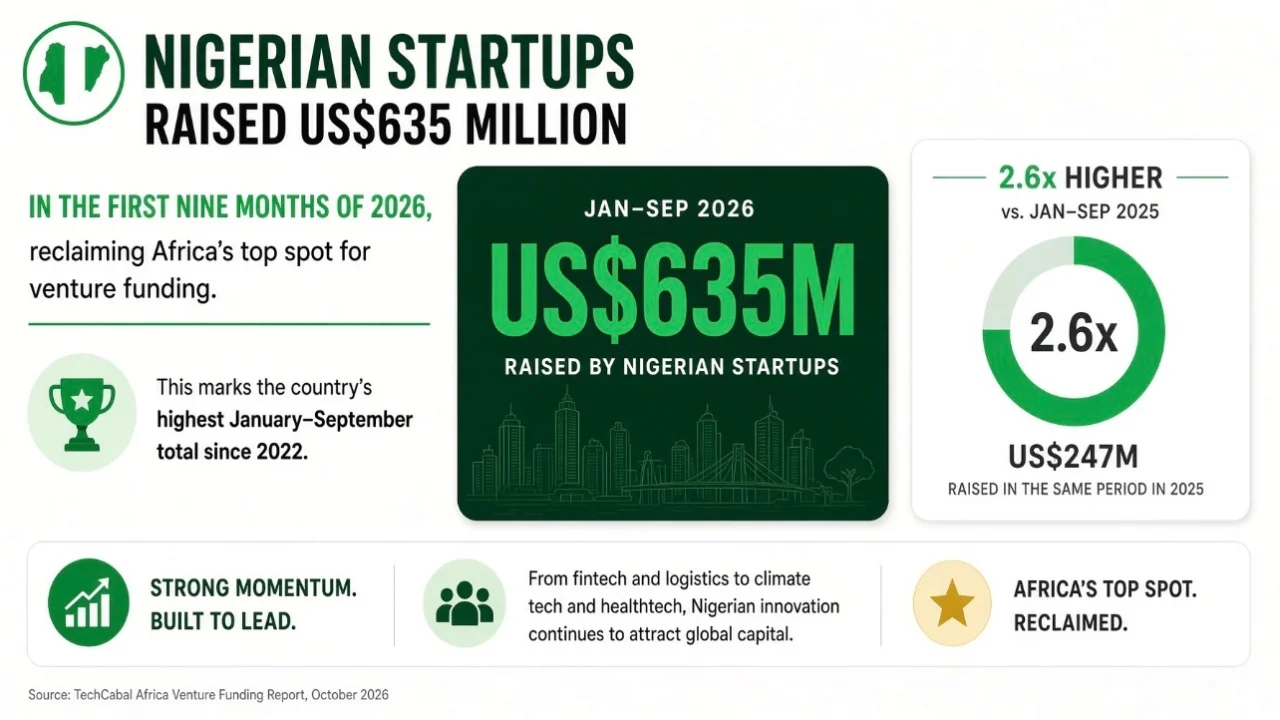
Nigerian technology startups secured $635 million in venture capital investments between January and September 2026, officially overtaking Kenya and South Africa to reclaim the top spot for tech funding on the African continent.
Data compiled by regional investment intelligence platform Africa: The Big Deal shows a strong resurgence in capital inflows. The $635 million haul marks a 157 per cent increase – a 2.6-fold surge – compared to the $247 million raised during the corresponding nine-month period in 2025.
Overall deal activity broadened across the country’s tech ecosystem, with 77 distinct startups securing funding rounds of $100,000 or greater, up from 70 deals logged within the same timeframe last year. Excluding pan-African multi-headquartered entities, Nigeria captured 37 per cent of all country-specific equity and debt capital deployed across Africa, registering its highest market share dominance since 2021.

The funding rebound was predominantly propelled by four mega-deals that concentrated $440 million, representing roughly 69 per cent of the nation’s total nine-month funding volume.
Leading the transactions was mobility-fintech unicorn Moove, which closed a $250 million Series C round that pushed its valuation to $2.1 billion. Payments infrastructure giant Flutterwave secured a $100 million Series E round backed by Ripple, elevating its valuation to $3.2 billion.
Pan-African e-commerce platform Jumia raised $50 million to enhance last-mile delivery and supply chain networks, while digital asset infrastructure provider Yellow Card completed a $40 million round to scale stablecoin settlement infrastructure across regional banking corridors.
Industry analysts noted that while the figures demonstrate renewed foreign investor confidence in Nigerian digital commerce, the high concentration of capital into a handful of mature players highlights persistent liquidity constraints for early-stage Pre-Seed and Seed founders.
To bridge the equity gap, emerging tech ventures are increasingly leaning on domestic venture debt, regional accelerators, and corporate innovation grants.