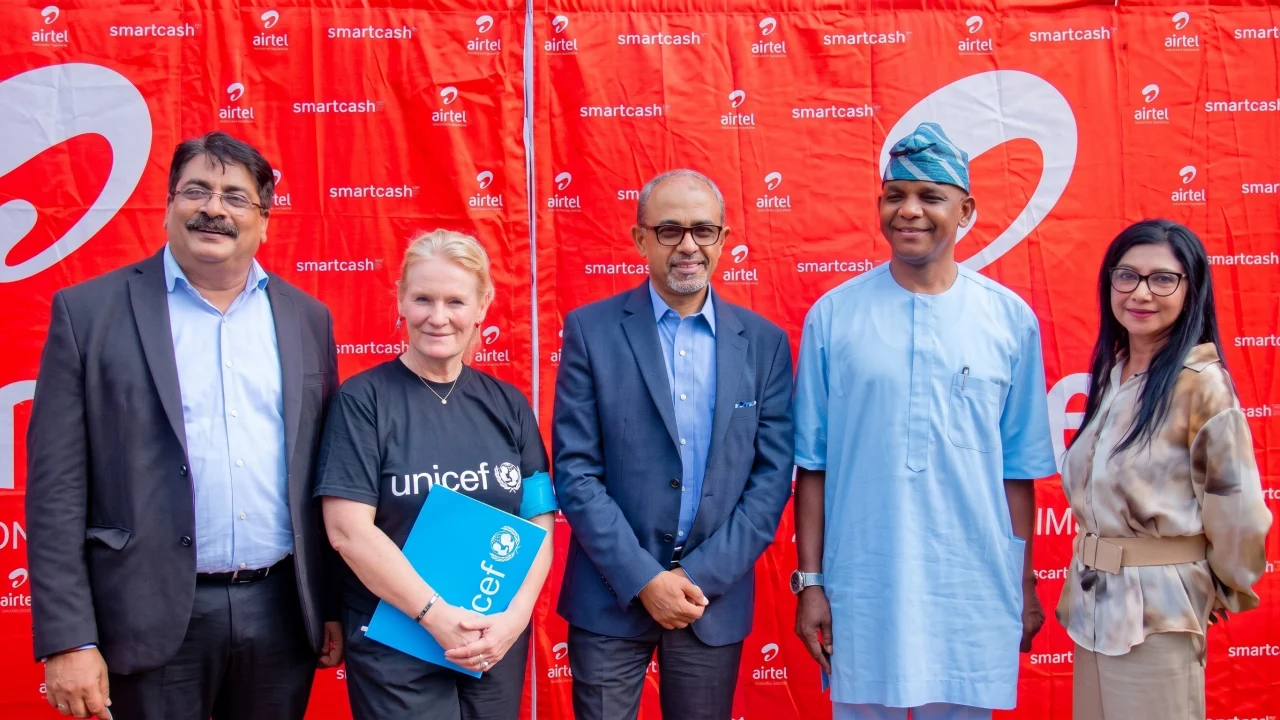
Telecoms operator Airtel Africa, the Airtel Africa Foundation, and the United Nations Children’s Fund (UNICEF Nigeria) have expanded their nationwide free digital education initiative, connecting nearly 2,000 primary and secondary schools and extending zero-rated learning tools to approximately one million students across the country.
The rollout follows a joint three-day assessment tour of public schools across Lagos State and high-level bilateral policy engagements with the Federal Government in Abuja.
Executed as a collaborative public-private partnership with the Federal Ministry of Education, the initiative seeks to eliminate financial and infrastructural barriers to quality remote learning in underserved communities. Beyond student reach, the programme has engaged over 20,000 educators nationwide, with more than 19,000 teachers completing specialized training in information and communications technology (ICT) and modern digital pedagogy.

A central operational feature of the partnership is network-level zero-rating. Under this mechanism, learners and teachers access state-approved educational portals via the Airtel mobile network without consuming personal mobile data or incurring airtime costs.
The whitelisted ecosystem includes the flagship Nigeria Learning Passport (NLP) – a digital management portal hosting curriculum-aligned modules and audiovisual content in English and major indigenous languages – which currently accounts for over 2.5 million registered students and nearly 100,000 educators. The data waiver also covers the Federal Ministry of Education’s Inspire and Ignite platforms, the Youth Agency Marketplace (YOMA) skills-development hub, and the Digital National Education Management Information System (NEMIS).
During field visits to public institutions in Lagos, including Government Senior College, Agege, and St. George’s U.N.A. Primary School, delegation leaders monitored live classroom sessions where pupils utilized the platform for foundational STEM courses. Esi Asare Prah, Head of Programmes at the Airtel Africa Foundation, highlighted strong female learner participation, noting that targeted connectivity interventions remain pivotal to closing historical gender divides in technology adoption.
In Abuja, the joint delegation met with key administration officials, including the Minister of State for Education, Prof. Suwaiba Sa’idu Ahmad. The minister affirmed that modernizing Nigeria’s basic education system requires scalable private-sector partnerships that seamlessly align interactive digital resources with national curricula while ensuring child online safety.
Nigeria represents the largest deployment market under the broader five-year Airtel Africa–UNICEF pan-African agreement, which targets connecting over 3,000 educational institutions and 2.5 million children across 13 countries on the continent.